Friday, 23 May 2014

Reacting to Neoreaction

Recently I have been taking an interest in an internet-based political movement called the "neoreactionary" movement- in practice, consisting of little more than a handful of bloggers who have used the medium of the internet very successfully to generate interest in their activities and philosophy. More pompously referred to as the "Dark Enlightenment," this fledgling ideology has been surprisingly well developed. The founder goes by the name Mencius Moldbug, who coined the term "Dark Enlightenment" and may or may not be a rejected Marvel villain. His thoughts can be found over at his blog Unqualified Reservations. Mr Moldbug is not very good at being succinct, and his posts are horrendously long and tedious- and this is coming from someone who managed to wade through The Communist Manifesto. As such I must confess that I have managed to conquer very little of Mr Moldbug's writings myself, but have relied principally on secondary sources for my understanding of neoreaction and the "Dark Enlightenment."

Edward, the Black Prince, kneels before his father
King Edward III; a vision of a world neoreactionaries
would like to see back, perhaps.
Other neoreactionary blogs, or blogs associated to some degree with Moldbug and his views, include More Right, run by a small group of neoreactionary thinkers ; The Anti-Democracy Activist, an anti-democratic, traditionalist blogger who has occasionally spoke of Moldbug with praise; Occam's Razor, who provides us with "reactionary musings from the Dark Enlightenment"; Foseti, who is mentioned everywhere and therefore must be important; and Outside In, another neoreactionary blog. Of course, there are others. These are just the ones I've come across and managed to read a little bit of. It's a very diverse group of people, with links to various other blogger communities that I had no idea existed, such as the "Manosphere". Which is about men, I'm sort of guessing. My interest in these bloggers was sparked by the revelation that at least a sizable proportion of them are monarchists, advocating for the return of hereditary monarchy and aristocracy (they are largely American, of course; here in the UK we still have hereditary monarchy and aristocracy, thank heavens, though they're somewhat watered down these days). The neoreactionary I have read the most, Michael Anissimov who is one of several contributors over at More Right, is particularly keen on monarchy, aristocracy and tradition. He is also a member of the "techno-commercialist" faction within the neoreactionary caucus, more on which later.

Apart from a common (though apparently not universal) desire to revive Europe's hereditary elites, there are a number of other canons of neoreactionary thought. Foremost among these is the idea of "The Cathedral," which neoreactionaries stridently oppose. "The Cathedral" is the neoreactionary name for the informal consensus between governments, the media and educators that supports Progressive ideology and works to silence any competing theory by branding any opposition as "evil" and "regressive" or "backwards." This is a great conspiracy that, like Goldman Sachs, can be imagined as a giant vampire squid wrapped around the face of humanity, sucking it dry. The Cathedral likes democracy and equality. Neoreactionaries therefore oppose both, and instead believe in strict social hierarchies. I'm a fan of hierarchies myself. However, beyond this there is a large degree of disagreement between competing factions of neoreactionaries. Some neoreactionaries have invented a system that classifies them into three distinct, but overlapping, groups; techno-commercialists, theonomists/religious traditionalists, and racists ethnicists/nationalists.

From the blog Habitable Worlds, a more complex
breakdown of the "Dark Enlightenment"
The techno-commercialists appear to have largely arrived at neoreaction via right-wing libertarianism. They are defiant free marketeers, sharing with other ultra-capitalists such as Randian Objectivists a preoccupation with "efficiency," a blind trust in the power of the free market, private property, globalism and the onward march of technology. However, they are also believers in the ideal of small states, free movement and absolute or feudal monarchies with no form of democracy. The idea of "exit," predominantly a techno-commercialist viewpoint but found among other neoreactionaries too, essentially comes down to the idea that people should be able to freely exit their native country if they are unsatisfied with its governance- essentially an application of market economics and consumer action to statehood. Indeed, countries are often described in corporate terms, with the King being the CEO and the aristocracy shareholders.

The "theonomists" place more emphasis on the religious dimension of neoreaction. They emphasise tradition, divine law, religion rather than race as the defining characteristic of "tribes" of peoples and traditional, patriarchal families. They are the closest group in terms of ideology to "classical" or, if you will, "palaeo-reactionaries" such as the High Tories, the Carlists and French Ultra-royalists. Often Catholic and often ultramontanist. Finally, there's the "ethnicist" lot, who believe in racial segregation and have developed a new form of racial ideology called "Human Biodiversity" (HBD) which says people of African heritage are naturally less intelligent than people of Caucasian and east Asian heritage. Of course, the scientific community considers the idea that there are any genetic differences between human races beyond melanin levels in the skin and other cosmetic factors to be utterly false, but presumably this is because they are controlled by "The Cathedral." They like "tribal solidarity," tribes being defined by shared ethnicity, and distrust outsiders.

Overlap between these groups is considerable, but there are also vast differences not just between them but within them. What binds them together is common opposition to "The Cathedral" and to "progressive" ideology. Some of their criticisms of democracy and modern society are well-founded, and some of them make good points in defence of the monarchical system. However, I don't much like them, and I doubt they'd much like me.

Louis XVIII, le Désiré, of France,
 first King of France and Navarre
after the Bourbon Restoration.
Whereas neoreactionaries are keen on the free market and praise capitalism, unregulated capitalism is something I am wary of. Capitalism saw the collapse of traditional monarchies in Europe in the 19th century, and the first revolutions were by capitalists seeking to establish democratic, capitalist republics where the bourgeoisie replaced the aristocratic elite as the ruling class; setting an example revolutionary socialists would later follow. Capitalism, when unregulated, leads to monopolies, exploitation of the working class, unsustainable practices in pursuit of increased short-term profits, globalisation and materialism. Personally, I prefer distributist economics, which embrace private property rights but emphasise widespread ownership of wealth, small partnerships and cooperatives replacing private corporations as the basic units of the nation's economy. And although critical of democracy, the idea that any form of elected representation for the lower classes is anathaema is not consistent with my viewpoint; my ideal government would not be absolute or feudal monarchy, but executive constitutional monarchy with a strong monarch exercising executive powers and the legislative role being at least partially controlled by an elected parliament- more like the Bourbon Restoration than the Ancien Régime, though I occasionally say "Vive l'Ancien Régime!" on forums or in comments to annoy progressive types. Finally, I don't believe in racialism in any form. I tend to attribute preoccupations with racial superiority to deep insecurity which people find the need to suppress by convincing themselves that they are "racially superior" to others, in absence of any actual talent or especial ability to take pride in. The 20th century has shown us where dividing people up based on their genetics leads us, and it is not somewhere I care to return to.

In conclusion, neoreactionaries would probably consider me to have been influenced by "The Cathedral," with my conciliatory view towards democracy, my rejection of racial differences and my criticisms of free market capitalism. God only knows what they'd make of my decidedly progressive views on environmental and animal rights issues. In future, in addition to more discussion of the fast-approaching Scottish independence referendum and Scottish/British monarchical history, I would like to delve more into my own ideological viewpoints and draw a picture of a traditionalist, monarchist, even reactionary world quite different to that presented by the neoreactionary movement. Still, I welcome debate, I welcome new support for the international reactionary cause, and I welcome the opportunity to discuss with neoreactionaries our mutual beliefs and interests- and perhaps even win some over to my side of the fence, and learn a little myself.

Not too much, though. An open mind is like a fortress with its gates unbarred and unguarded.

Thursday, 22 May 2014

The Prince of Wales on Vladimir Putin

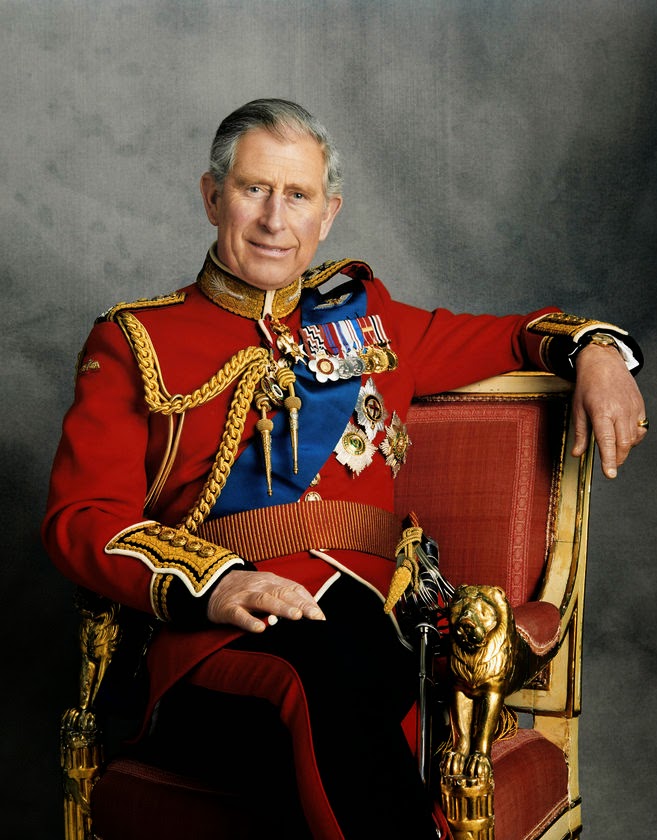
HRH Charles, Prince of Wales, Earl of Chester, Duke of Cornwall,
Duke of Rothesay, Earl of Carrick, Baron of Renfrew, Lord of the Isles and
Prince and Great Steward of Scotland, occasional prophet.

Recently the press has been getting itself worked up about the alleged comments of our future King, Charles, Prince of Wales and Duke of Rothesay, among other things. In light of the Scottish monarchy theme of this blog- none other than King James IV of Scotland is my avatar and the blog's mascot- I will henceforth refer to him as Duke of Rothesay. His Royal Highness is reported to have likened the strongman ruler of the pseudo-democratic Russian Federation, Vladimir Putin, to a certain Adolf who governed Germany in the 1930s and 40s and is generally considered to have been a very bad person. The remarks were made by the Duke of Rothesay in a private conversation with Marienne Ferguson, a museum volunteer at the Canadian Museum of Immigration, Nova Scotia. Mrs Ferguson lost relatives during the Holocaust, and was telling Prince Charles about her experiences when he apparently noted that "now Putin is doing just about the same as Hitler."

Should the heir to the throne be making such remarks in public? That's a moot point, because the conversation was private. He certainly didn't offend Mrs Ferguson, who told the press "I must say that I agree with him and am sure a lot of people do. I was very surprised that he made the comment as I know they [members of the Royal Family] aren’t meant to say these things but it was very heartfelt and honest." I certainly agree with the Duke of Rothesay and Mrs Ferguson on this. Many Ukrainians and other eastern Europeans who feel threatened by Russia's aggression probably stand with us on this. Labour leader Edward Miliband is with us, too. Are you?

Of course, Russia says His Highness' remarks are outrageous. "We view the use of the western press by members of the British royal family to spread the propaganda campaign against Russia on a pressing issue – that is, the situation in Ukraine – as unacceptable, outrageous and low," says Alexander Lukashevich, who is apparently the voice of the Russian foreign ministry. UK Independence Party leader Nigel Farage, who has expressed admiration for Putin in the past, is with the Russians. You can kiss goodbye to my vote, Nigel. Nick Clegg has proved he does sometimes have a rational thought, saying, "I have never been of this view that if you are a member of the Royal Family, somehow you have to enter into some Trappist vow of silence. I think he is entitled to his views. But I don't know whether those were his views because I just don't think providing a running commentary on what were private conversations is useful to anybody. I don't know exactly what he did or didn't say in that conversation because he thought it was a private conversation."

Very sensible, Mr Clegg. David Cameron is also being sensible; "I am not going to comment on someone's private conversation, least of all Prince Charles," he told Channel 4 News. Still, the Russians are determined to make this into a foreign relations crisis. They want a meeting with the Foreign Office, in order to "clarify" the Duke of Rothesay's remarks. The Foreign Office intends to use the opportunity to reiterate their disapproval of Russia's actions in Ukraine. Perhaps they could also give the Russians a wee history lesson. In 1938, shortly after the Anschluss was completed merging Austria into Germany, ethnic Germans in the fertile Sudetenland in western Czechoslovakia began agitating for autonomy. Adolf Hitler responded by accusing the Czechoslovakian government of oppressing Sudeten Germans, and signed a secret directive for mobilisation to begin for war with Czechoslovakia. Under pressure from the British and French, the Czechoslovakian government agreed to the Sudeten Germans' four demands, only for Sudeten Germans intent on triggering war between Czechoslovakia and Germany to begin a wave of protests that destabilised talks; the Czechoslovakian army was eventually deployed to restore order.

Partition of Czechoslovakia in 1938, compliments of Wikipedia.
Under the pretext of protecting ethnic Germans from Czechoslovakian oppression, Hitler demanded the immediate annexation of the Sudetenland into the German Reich. The British and French governments, desperate to avoid war with Germany, agreed. Czechoslovakia resisted; however, despite the mobilisation of the Czechoslovakian Army and the promise of Soviet aid, the President of Czechoslovakia was unwilling to risk war with Germany without British and French support. On 29 September, the Munich Agreement was signed by Germany, Italy, France, and Britain, effectively ceding the Sudetenland to Nazi Germany without consulting the Czechoslovakian government. Soon after, the Nazis occupied the Sudetenland and forced Czechoslovakia to surrender large chunks of its territory to neighbouring Hungary and- irony of ironies- Poland. Nonetheless, Czechoslovakia would soon be invaded by Germany and all of Bohemia, the modern Czech Republic, annexed. Slovakia was set up as a nominally independent puppet state of the Third Reich.

Does all this sound familiar? It should- substitute Czechoslovakia for Ukraine, the Crimea for the Sudetenland and Russia for Germany, and the parallels become clear. Any student of history ought to be able to see how Putin, and ex-KGB agent who has mourned the fall of the Soviet Union in public, has taken actions reminiscent of Hitler in his early days. I can see it, Prince Charles can see it, Mrs Ferguson can see it, Ed Miliband can see it. Russia may not be on the road to ethnic cleansing, but its actions are clearly very sinister. Prince Charles has the right to say as he pleases in a private conversation, but let's say he had said it in a public address instead- perhaps that would have been a misstep, and perhaps he would have been criticised for it. But perhaps people would look back on his utterings fifty years from now, and see him as a latter-day Cassandra, the Winston Churchill of our time, his sound warnings ignored by the people around him. Perhaps we should listen to him now.

The views of Russia's true head of state, HIH Grand Duchess Maria Vladimirovna, the legitimate Empress and Autocrat of all the Russias, on the Ukrainian crisis can be found here at the Imperial House's website. As might be expected the tone is pro-Russian, but much more reconciliatory and measured than that of the Kremlin. I beg Her Imperial Highness' forgiveness if I appear overly critical of Russia's foreign policy here; I assure the Grand Duchess, and other proud Russian patriots, that my issue is entirely with Vladimir Putin and his neo-Soviet comrades, not with the people of Russia. Let us pray cooler heads prevail in east and west. Боже, Царя храни! God Save the Queen!

Friday, 2 May 2014

307th Anniversary of the Founding of the Kingdom of Great Britain

 
The "King's Colours," the national flag of the Kingdom of Great Britain- originally designed on the orders of
King James VI and I to be used on English and Scottish ships on the high seas.
Yesterday was 1st May, the 307th anniversary of the union of the Kingdom of England and the Kingdom of Scotland to found the new Kingdom of Great Britain. Of course, the two kingdoms had been united under the same monarch since James VI, King of Scots, ascended to the throne of England on 24th March 1603. James VI and I was the first monarch to style himself "King of Great Britain," and had coins minted in Scotland proclaiming himself such; but in England, where his power was not so absolute, coins proclaimed simply as "King of England," and James was officially King of England, Scotland, France and Ireland (Kings of England having claimed the French throne, at least de jure, since 1340, and continuing to do so until George III relinquished the title in 1800) until his death.

Anne, Queen of Great Britain, the first monarch of
a united Kingdom of Great Britain
On the 1st March 1707, however, the Acts of Union passed by the Scottish and English Parliaments came into force; both Parliaments merged into a new British Parliament and Anne, Queen of England, Scotland, France and Ireland became Anne, Queen of Great Britain, France and Ireland. Wikipedia helpfully provides the following quote from historian Simon Schama on the union; "What began as a hostile merger, would end in a full partnership in the most powerful going concern in the world ... it was one of the most astonishing transformations in European history." Certainly, this did begin as something of a hostile merger. Queen Anne had been a key supporter of further integration of her kingdoms since coming to the throne in 1702 at the age of 37,  declaring it "very necessary" to conclude a union of England and Scotland in her first speech to the English Parliament. This was in part influenced by the risk of Scotland and England finding themselves under separate monarchs after Anne's death, if she had no children, as the Act of Settlement 1701 designating the Protestant Electress Sophia of Hanover as Anne's heir applied only to England and Ireland, which was not then a truly autonomous kingdom as Scotland was. The Scots, an influential minority of whom wished to preserve the rights of the Stuart dynasty to the throne rather than allow the German Hanovers to take over (and why not? The House of Stuart was a homegrown Scottish dynasty, after all, so such loyalty was more warranted in Scotland than in England), passed the Act of Security in 1704 that reserved for the Scottish Parliament to choose its own monarch following Anne's death, and not the same successor as the one chose by England unless certain conditions were met.

These conditions included the full freedom to trade in England for Scottish merchants. At the time, Scotland's economy was in trouble, the ambitious Darien scheme aimed at establishing a Scottish colony in modern day Panama and making Scotland a major international trading power. Unfortunately the Spaniards had scuppered the idea, and Scotland, having invested a quarter of the money circulating within its borders in the scheme since those slimey Dutch and English investors had pulled out, found itself in rather serious debt. Making money was therefore top of the Scots' minds at the time. England decided to fight back with the Alien Act 1705 which threatened Scotland with economic sanctions and declared Scots in England to be aliens (i.e. foreign citizens, despite being subjects of the same Queen, with limited economic and social privileges). Scotland, given a choice between negotiating a full political union with England or withdrawing the Act of Security, opted for union. A new joint Anglo-Scottish commission was set up to negotiate the terms of the union, and the Acts of Union were passed by the Parliaments of England and Scotland.


Floral badge of the Kingdom of Great Britain,
incorporating the Tudor rose and a
Scottish thistle.
There was little appetite for union in Scotland at the time. Indeed, Parliament had to impose martial law in order to suppress the anti-unionist riots, the Convention of Royal Burghs which represented the interests of the citizenry of Scotland's principal trading towns submitted a petition against the union, and on the day the treaty was signed, the carilloner in St Giles Cathedral, Edinburgh, rang the bells in the tune Why should I be so sad on my wedding day? However, the bride and groom of this arranged marriage did in time come to love each other, it would seem. Great Britain has proved a successful project, becoming the heartland of the industrial revolution and centre of the largest empire in human history, stretching around the globe so that it could be said that the sun never set upon the British Empire. Scots would play a major role in the rise of this empire, and far from the modern historical narrative of Scottish nationalists that Scotland was the first victim of English imperialist aggression, often Scotsmen were the driving force behind Britain's rise to imperial glory. It almost seems that having failed to build an empire on their own, the Scottish elite concocted a dastardly plan to feign submission to the English and then achieve their ambition of a Scottish Empire under the pseudonym of "Great Britain" and with English money and manpower to aid them. In 2002, author Michael Fry published a book, The Scottish Empire, chronicling Scottish involvement in the rise of the British Empire and bringing to light the Scots' status as partners, not servants, of the English in bringing Christianity, parliamentary democracy and afternoon tea to the world.

Although the Scots may not have entered the union willingly, in the long term they clearly benefited from it. Today Scotland retains the benefits of being part of a major world power, being defended by one of the world's most powerful militaries and being a part of the world's 6th largest economy, but has also regained much of its autonomy with its own parliament at Holyrood once more. It's a good deal. Scots should not just vote against independence this year for the perks, however; I hope they vote to remain British because they are proud to be British, and because since 1707, we Scots, Englishmen, Welshmen and even the remaining Irishmen in the United Kingdom have built a shared British identity that we can be proud of- without sacrificing our local identities. As a proud son of Scotia and Britannia, I wish you all a happy "Union Day." Long may it endure!

Tuesday, 29 April 2014

The Duke and Duchess of Cambridge's 3rd Wedding Anniversary

Yes, you read the title right. I can't be the only one who finds it hard to process that the Duke and Duchess of Cambridge- the media like to call them "Kate and Wills," but here at the Rose and the Thistle we like to keep up standards when it comes to royal etiquette- were married three years ago today. It seems only yesterday we were treated to the pageantry of a royal wedding, to the soon-to-be Duchess' magnificent wedding dress, to Prince William in his smart military uniform, to the glorious procession of the household cavalry accompanying Their Royal Highnesses' back to Buckingham Palace in the state carriage as adoring crowds lined the Mall, holding aloft British and other commonwealth nations' flags and banners with kind words for the newly married couple. It was a spectacular warm-up to an even rarer royal event, 2012's Diamond Jubilee, when Queen Elizabeth II celebrated her 60 years on the throne of the United Kingdom, Antigua and Barbuda, Australia, the Bahamas, Barbados, Belize, Canada, Grenada, Jamaica, New Zealand, Papua New Guinea, Saint Kitts and Nevis, Saint Lucia, Saint Vincent and the Grenadines, the Solomon Islands and Tuvalu. Even if, admittedly, several of those nations did not exist as independent states upon her ascension to the throne of the then British Empire and Commonwealth.

 
The Coat of Arms of the Duke and Duchess of Cambridge. Quite fetching, if you ask me.

Recently the young Duke and Duchess have returned to the news. Their Royal Highnesses have just returned to the UK following a successful tour of Australia and New Zealand. I have been hugely encouraged by figures showing that support for the monarchy is strong among 18-34 year old Australians. This bodes well for the long-term security of Australia's monarchy. It is also encouraging to see how well the Duchess of Cambridge has settled in to her royal role; comparisons to her late mother-in-law Diana, the Princess of Wales, have been rife in the British press. That said, I often think such comparisons are unfair and place a great deal of pressure on the Duchess to live up to her mother-in-law's illustrious reputation, which has cast a long shadow over royal life ever since her tragic loss in 1997.

All in all, it has been a royal whirlwind for the last three years, but our future King and Queen have weathered it well. Republicanism remains a damp squib across the commonwealth realms. This month our Sovereign celebrated her 88th birthday, and Her Majesty shows no signs of slowing down. I'm sure her subjects the world over will join me in wishing Her Majesty many years on the British throne and the thrones of her other territories (and seeing as Her Majesty Queen Elizabeth The Queen Mother made it to the grand old age of 102, who knows how long our current monarch will reign), but it is comforting to see the affection afforded by those subjects to Her Majesty's eventual successors. Fate allowing, some day I may be blessed to see the coronation of King William V and his queen, Catherine. 'Till then, three cheers for the Duke and Duchess of Cambridge!

Hip, hip, hooray!
Hip, hip, hooray!
Hip, hip, hooray!

Thursday, 10 April 2014

Battle of Midtskogen

Their Majesties King Haakon VII and Queen Maud of Norway in
their coronation attire
Today is the 74th anniversary of the end of the Battle of Midtskogen in the Kingdom of Norway, when Nazi German forces under the command of Eberhard Spiller attempted to capture the King of Norway, Haakon VII, and his cabinet in order to force Norway into submission. The Norwegian force consisted of one rifle company of the King's Guards, the unit of the Norwegian Army responsible for the defence of Norway's monarch, and a number of volunteers primarily from local rifle clubs. The German force consisted of a small raiding party of paratroopers. The battle ended in a victory for the Norwegian forces, the Nazis failing to capture the King so he and his cabinet were able to escape to the United Kingdom and form a government in exile rather than be turned into a puppet of the occupying German Army. Casualties were light on both sides- two Germans were killed and only three Norwegians wounded- but this was a great moral victory for Norway.

The Germans invaded the Kingdom in 1940 despite Norway declaring independence at the outset of the war as Norway was of great strategic importance to both sides. Controlling Norway secured the Germans' supply of iron ore from Sweden, and also allowed Germany to use its sea power more effectively. Air raids on the United Kingdom were also conducted from captured German airfields. And, ridiculous as it seems in retrospect, the Nazis feared that the British would launch their own invasion of Scandinavia, which would give the Royal Navy the ability to strike the German Kriegsmarine in the Baltic. Approximately 6,602 Norwegian and Allied troops died, were injured or went missing while defending Norway from the German invasion, and around 400 Norwegian civilians were also killed in the crossfire; the Germans lost 5,296 troops. The Norwegian Armed Forces in Exile and the underground Norwegian Resistance would continue to fight for Norwegian liberation against the Third Reich until the end of the war. On this anniversary, I wish to join the people of Norway in celebrating the safe delivery of their King to Great Britain and the ultimate victory of the Allies against the Third Reich, and in commemorating those who gave their lives for the cause of Norwegian liberty. A Norwegian diplomat, Halvard Lange, once said  "We do not regard Englishmen as foreigners. We look on them only as rather mad Norwegians." If that is the case I can proudly call myself a mad Norwegian, and so raise a toast to "our" King.

Lenge leve kongen! Enig og tro til Dovre faller!

Wednesday, 9 April 2014

The United Kingdom, Ireland and President Higgins' State Visit

His Excellency the President of Ireland (or, in Irish Gaelic, a Shoilse an t-Uachtarán na hÉireann) yesterday made the first ever formal state visit by an Irish head of state to the United Kingdom, being Her Majesty's guest at Windsor Castle. Both the President and the Queen made speeches, with the Queen's speech being particularly enjoyable for monarchists due to her beginning by paying tribute to the "greatest of Ireland's High Kings," Brian Boru, who died in battle one hundred years ago this month. The High King, who styled himself "Emperor of the Irish," was tragically killed by fleeing Norsemen as they stumbled upon his tent after he led Irish forces to victory against them in the Battle of Clontarf. His death was one of those fateful moments which may well have altered the course of history in ways we cannot guess, and Ireland collapsed once more into a loose association of squabbling petty kingdoms.

George VI, the last King of Ireland
Of course, the final monarch of all Ireland was the Queen's own father, His Majesty King George VI, who was monarch of both Northern Ireland (as part of the United Kingdom) and what is now the Republic of Ireland (then the Irish Free State) until 1949. Today, unfortunately, monarchy is regarded in Ireland as permanently "tainted" by association with British colonial rule. Ironically, Sinn Féin itself was once a staunchly monarchist party calling for a dual monarchy in the British Isles based on the model of the Austro-Hungarian Empire. This only changed following the Easter Rising, the leadership of which were much more radical than the then-leadership of Sinn Féin. Unfortunately the rising was mislabelled as an "Sinn Féin Rising" by the press, Sinn Féin members were unfairly blamed and persecuted, and nationalists rallied under the banner of Sinn Féin calling for an independent Irish Republic; all of this, despite King George V personally criticising the Government's response to the Rising.

1826 oil painting of the Battle of Clontarf, by Hugh Frazer
I could go into more detail about my thoughts on the Easter Rising, and on subsequent Irish history; in some future post I probably will do so. However, what is past is past- the core message of both Her Majesty and President Higgins' speeches yesterday- and now is a time for looking to the future. Although it is, to my mind, regrettable that history did not transpire differently and that Ireland is not today a united, self-governing kingdom in personal union with Great Britain and with Queen Elizabeth II as its beloved High Queen, the state visit yesterday and the Queen's recent state visit to Ireland are encouraging signs of rapprochement between the Republic and the United Kingdom. The only blot in the landscape as I see it was the presence of Martin McGuinness, currently Deputy First Minister of Northern Ireland and former Chief of Staff of the Irish Republican Army. The fact that this terrorist who was among the IRA's leadership when they murdered the Queen's cousin Lord Mountbatten (a memorial to whom the President visited and laid a wreath at yesterday) was allowed to sit at Her Majesty's table does not sit comfortably with me, nor do I expect it sits comfortably with the survivors and families of the victims of the IRA's terror campaigns; especially so soon after there was public outrage over the pardon of IRA members who took part in terrorist activities, including John Downey, a suspect in the 1982 Hyde Park bombing, who was handed a pardon as the result of an "error." Meanwhile, a paratrooper involved in the events of "Bloody Sunday" complains that a promise of anonymity he received in return for giving detailed evidence in a previous enquiry has been revoked by a new police inquiry.

Michael D. Higgins, President of Ireland, meets Her Majesty the Queen and
His Royal Highness the Duke of Edinburgh
Despite this controversy, on the whole the Uachtarán's state visit- I think I prefer the Irish name to the English word, although Ard Rí would be preferable- has been a success. Hopefully more such visits will follow, and in time past wounds will heal as the peoples of the British Isles become not merely good neighbours, but steadfast friends and allies. As Mr. Higgins, a poet and clearly a natural one, put it, "Ireland and Britain live in both the shadow and in the shelter of one another, and so it has been since the dawn of history. We celebrate what has been achieved but we must also constantly renew our commitment to a process that requires vigilance and care."

Sunday, 6 April 2014

For Queen and Country


This is the first post I have ever made to my first ever blog, so naturally I want to start by thanking anyone who actually takes the time to read this. If you are reading this, you may well have worked out by now the nature of this blog- this is the blog of a proud British patriot, monarchist and traditionalist, and is written from that point of view. My ambition is simply to add my voice to a growing chorus calling for Western civilization to revisit the values it has largely turned its back on; social hierarchy, chivalry, faith, loyalty, sustainability, localism and above all the basis of all great civilisations, the monarchy. At the same time, I wish to highlight which voices amidst the chorus represent true wisdom and which would lead us all down a very dark path indeed- the mantle of traditionalism has been usurped increasingly in recent times by those who subscribe to decidedly unsavoury ideas of racial supremacism, authoritarianism and ultra-nationalism.

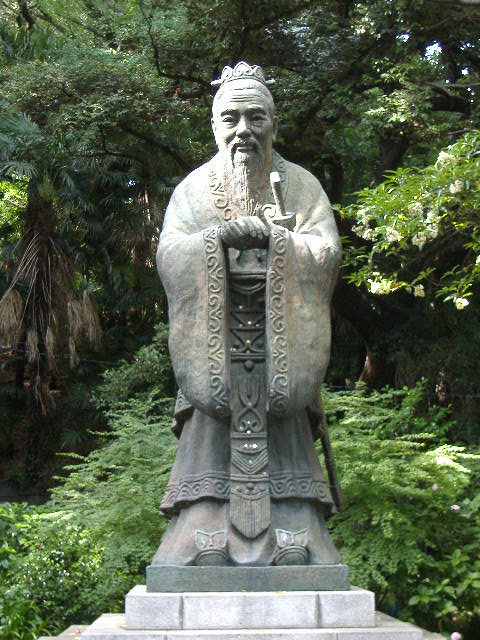
"From the Son of Heaven down to the mass of people, all must consider the
cultivation of the person the root of everything besides." - Confucius
Although I have a particular interest, in light of the Scottish secession referendum fast approaching us, in promoting Scottish monarchism and British unionism by promoting knowledge of and interest in Scotland's rich royal past and countering the arguments of nationalists and republicans, I have no intention of limiting the scope of this blog to Scotland or even to the British Isles. Throughout the world there are grave injustices to be righted, great civilisations crumbling and solutions from history and tradition that are being overlooked. More than any other thinker, Confucius has influenced my view of the proper organisation of society and the path to becoming a man (or woman) of virtue, and yet today his teachings are being corrupted as a way of propping up the Chinese socialist regime that is responsible for destroying his legacy, all the achievements of some 2,000 years of Imperial rule handwaved with the label of "feudalism." The Islamic world, once a shining beacon of civilisation, of science, faith and good government, is now seen as a backwards, war-torn place by the rest of the world. One hundred years after the start of the war that spelled doom for the House of Romanov, Russia is governed by a former member of the Soviet-era secret police and dominated by organised crime.

Adolf Freiherr von Harnier, hero of the Bavarian monarchist
movement, enemy of the Nazis, and my long time hero.
Society today faces some of the greatest challenges humanity as a species has ever been faced with, whether we realise it or not. A growing population is putting increased pressures on  finite resources that are inevitably running out; the natural environment is suffering as a result of human activities; morality is becoming unfashionable across the developed world, and a tool of oppression in developing countries; since the 1940s, for the first time in the Earth's history a living organism- us- have possessed the power to cause destruction on a scale previously reserved for Mother Nature, equipped as we now are with nuclear weapons of mass destruction. Never before have we been in greater need of our collective experience and the words of history's wisest men and women to guide us through tumultuous times. The keys to our future lie in the past. It is by looking to the past that we will find our salvation.